
Why 88% of Partnerships Fail in Execution And How to Be in the 12% That Succeed
Most organizations know how to close deals. Few know how to sustain them. The RIGHT Model shows you how to design partnerships that don’t just launch but also last.


You’ve Seen This Pattern Before
The partnership starts strong. Everyone’s aligned. The agreement looks good on paper.
- Expectations drift apart
- Communication breaks down
- Small problems become big ones
- Trust begins to erode
By month 12, you’re wondering what went wrong.
Here’s what actually happens:
- The deal was negotiated at the executive level. But thebehavioral infrastructureneeded to sustain it was never built.
- You optimized for closing the deal. Not for what happens after.
In complex networkswhere health systems, home care agencies, CBOs, and social service organizations must coordinatebehavioral infrastructureisn’toptional.
It’s the difference between partnerships that scale and partnerships that fail.

In Sustainable Networks, Deals Are Entry Points Not Endpoints
Most organizations treat signed agreements as finish lines.
But in networked environments, where value creation is interdependent and nonlinear—the real work begins after the contract is signed.
What determines durability isn’t the terms you negotiated.
- It’s the behavior patterns that emerge during execution:
- How information flows between organizations
- How decisions get made when circumstances change
- How trust compounds (or erodes) through repeated interactions
- How power and discretion are exercised
- How growth is managed without fracturing incentives
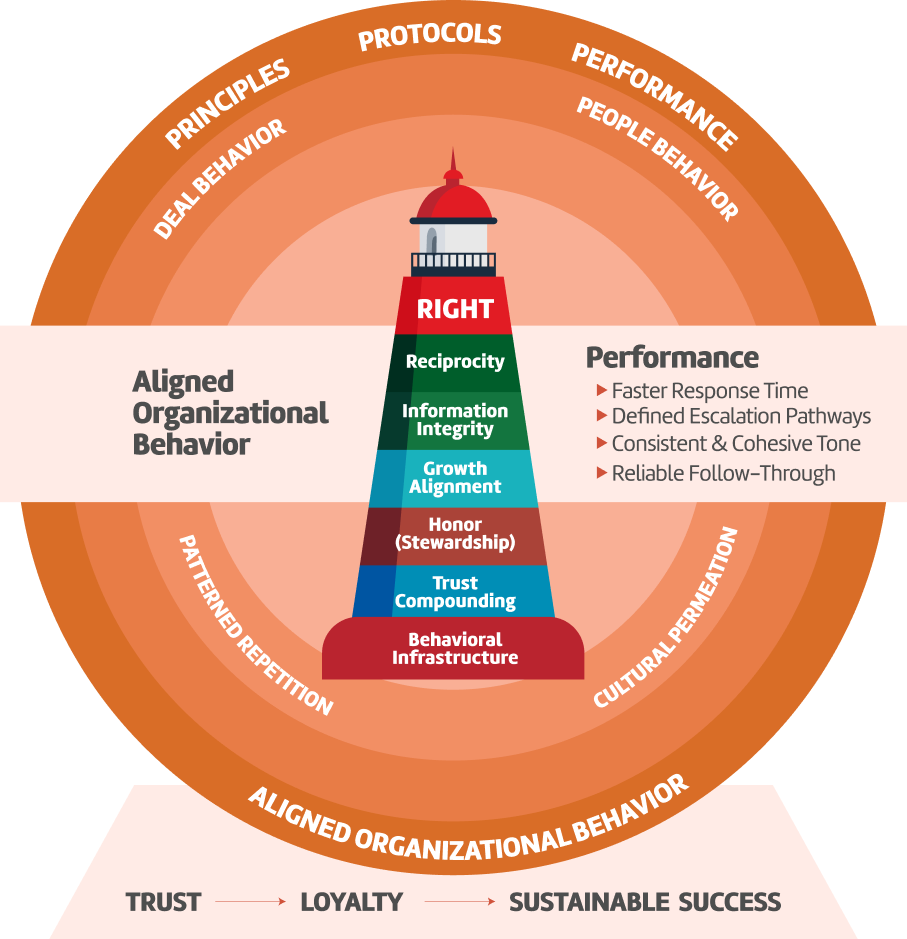
- The Anchor Group RIGHT Model is a design framework for building durable, trust-based networks.
It reframes “doing the right thing” not as an ethical posture, but as behavioral infrastructure. A way of structuring agreements, organizations, and interactions so that cooperation becomes the rational default.

The RIGHT Model: Five (5) Behavioral Pillars for Sustainable Networks
The RIGHT Model is a recognition toolkit — a framework for designing behavior
in multi-party systems where trust, alignment, and accountability must be sustained over time.

Who Should Read This?
The RIGHT Model is designed for leaders building and managing complex partnerships across health, social care, and community systems including:
- Healthcare executives managing hospital–community partnerships and value-based care networks
- Home care agency leaders coordinating with MCPs and referral partners
- Community-based organization (CBO) directors leading multi-stakeholder collaborations
- Government and public health leaders designing cross-agency programs
- Social care network builders integrating health and community services
- Partnership and business development leaders responsible for strategic relationships
What You’ll Learn in the RIGHT Model Guide
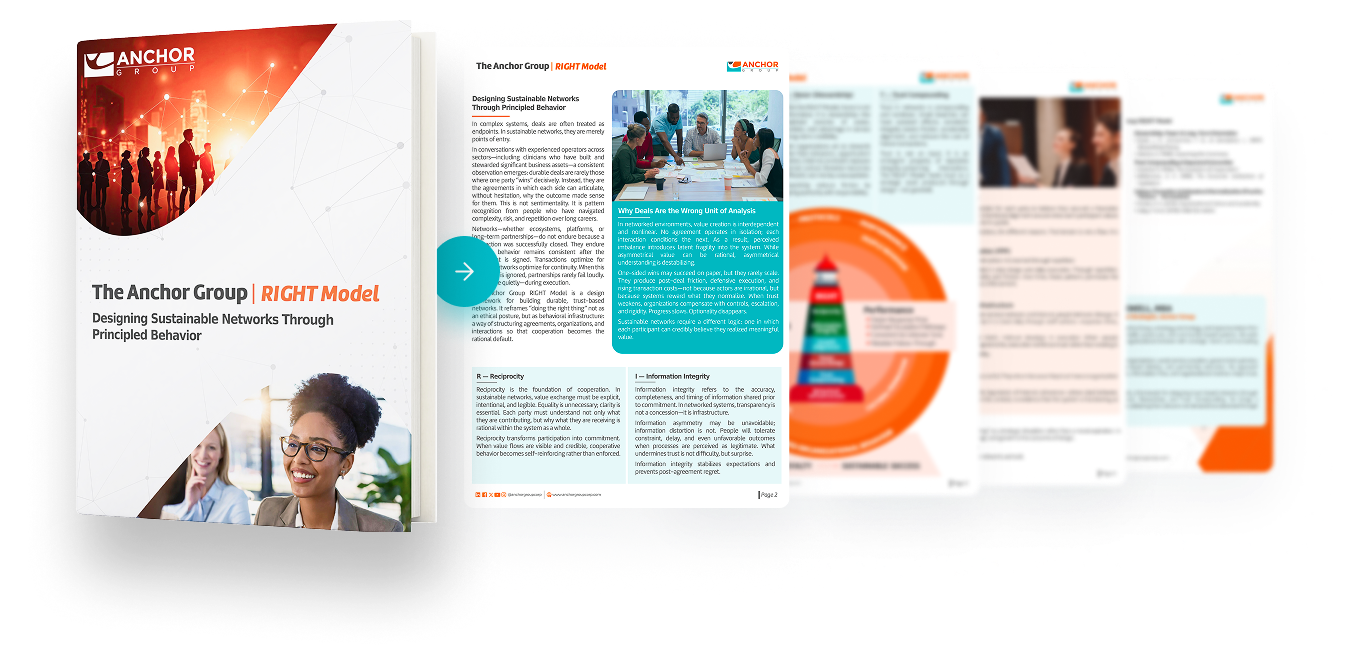
This isn’t a theory paper. It’s an operational framework backed by behavioral science research and field-tested across health and social care networks.
The Core Framework
Complete breakdown of all five RIGHT Model pillars with practical application guidance
Why the Best Network Deals Feel Like a “Steal”
How to design agreements where each party believes they secured favorable terms (and why that’s strategic, not accidental)
From RIGHT to Culture: Practice, Pattern, Permeation (PPP)
How behavioural frameworks become organisational culture through repetition, not declaration
Alignment Between Deal Behavior and People Infrastructure
Why external partnership behaviour and internal staff behaviour must align—or trust erodes in execution
Client Return as Evidence, Not Strategy
How to know if your behavioural infrastructure is functioning (clients return because they trust how you behave, not just what you deliver)
Implementation Guidance
How to apply RIGHT principles to partnership design, organisational operations, and network governance
Plus: Real-world examples, diagnostic questions, and frameworks you can adapt immediately.
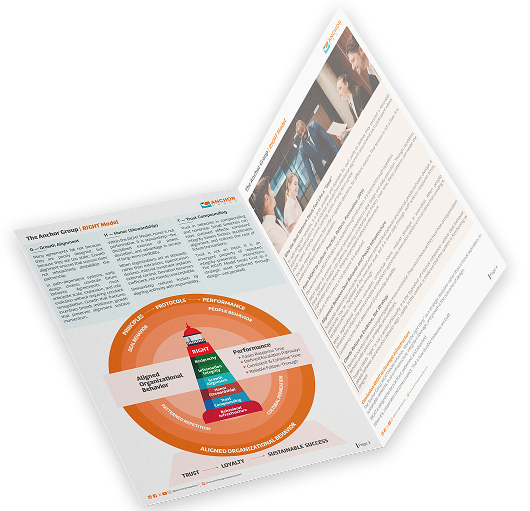
See How Mature Your Network Management Strategy Really Is
As the healthcare system shifts toward value-based, coordinated care—requiring health systems, community organizations, and social care providers to operate in integrated networks—the RIGHT Model provides the behavioral infrastructure needed to build trust, align partners, and sustain high-performing collaborative ecosystems.
Identify gaps, align your team, and take the next step toward high-performing, integrated partnerships.

About Kevin Howell & Anchor Group
About Kevin Howell & Anchor Group
Kevin Howell is the Founder and Lead Strategist of Anchor Group, a strategy, technology, and implementation firm focused on designing sustainable networks across health, social care, and community-based systems.
Over the past decade, Kevin has advised healthcare organizations, social service providers, government partners, and platform operators on network design, value-based delivery, and partnership execution. His work centers on behavioral architecture—how incentives, information flow, and organizational routines shape trust, performance, and long-term collaboration.
Kevin created the RIGHT Model after observing a consistent pattern: partnerships that looked sound on paper frequently failed in execution—not because of bad intent, but because the behavioral infrastructure needed to sustain them was never designed.
Kevin Howell is a founder and lead strategist at Anchor Group,
specializing in network strategy and execution.
His work helps organizations build systems that sustain alignment,
trust, and performance across complex partnerships.