
Anchor Group Framework
The RIGHT Model
Designing sustainable networks through principled behavior. A framework for building trust-based partnerships that endure — not because they were negotiated well, but because they were designed right.
“Networks do not endure because a transaction was successfully closed. They endure because behavior remains consistent after the agreement is signed.”
— Kevin A. Howell, MBA | Founder, Anchor Group
The problem
Why partnerships fail during execution
The most common network failure pattern is quiet. Not a dramatic breach. Not a visible conflict. A slow erosion during execution — response times lengthen, follow-through becomes inconsistent, partners begin hedging, and the relationship that looked strong at signing gradually hollows out.
Most organizations treat deals as endpoints. In sustainable networks, they are merely points of entry. What happens after signing — how behavior holds under pressure, ambiguity, and growth — determines whether a network endures.
Asymmetrical understanding
Asymmetrical value can be rational. Asymmetrical understanding is destabilizing. When one party cannot articulate why the deal makes sense for them, latent fragility is designed in from day one.
Trust treated as an input
Organizations treat trust as something that exists before the work begins. The RIGHT Model treats trust as a strategic asset that must be actively produced — through design, not goodwill.
Behavior without infrastructure
Executive intent rarely survives the distance between the boardroom and the frontline. When staff behavior contradicts contractual intent, trust erodes in execution — not at signing.
Static agreements in dynamic systems
Many agreements fail not because they are poorly designed, but because they are too static. When growth changes the balance of the relationship, deals that were never built for evolution fracture.
The framework
Five dimensions of network design
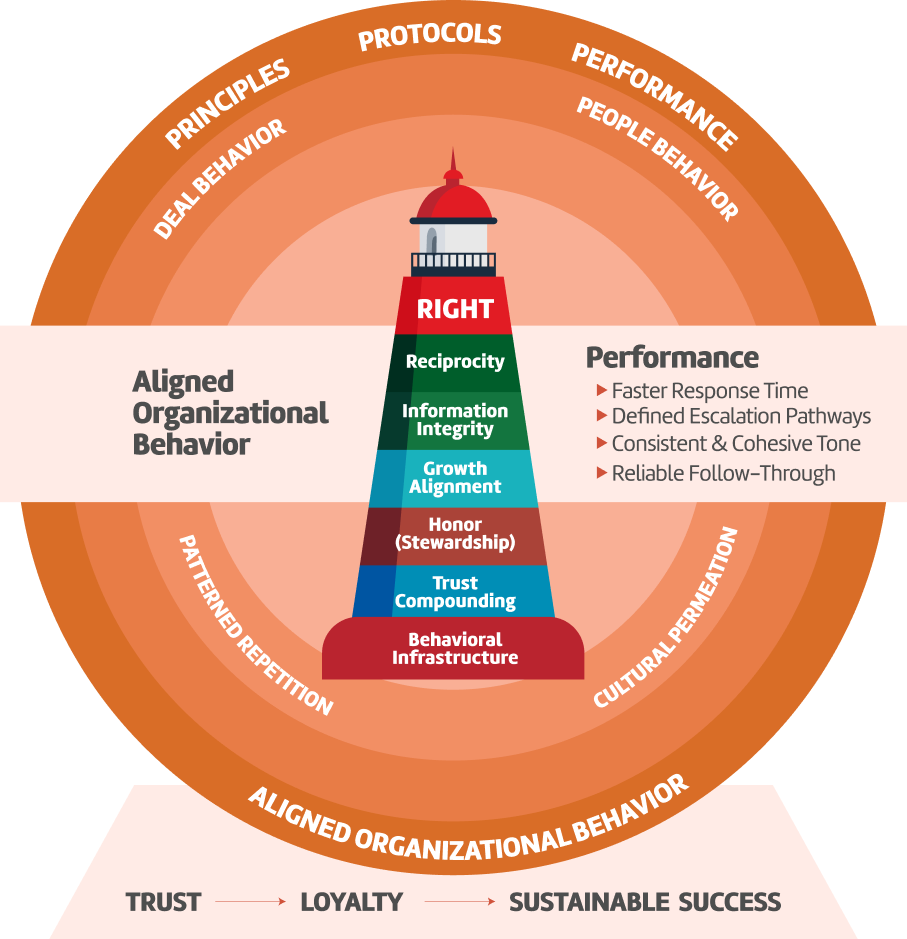
RIGHT is an acronym that encodes the five behavioral dimensions of sustainable network design. Each dimension addresses a specific failure mode. Together they form a self-reinforcing system in which the rational choice is also the trust-building choice.
RIGHT is not about being agreeable. It is about designing conditions in which the right behavior is also the most efficient behavior.
Foundation of cooperation
Value exchange must be explicit, intentional, and legible. Equality is unnecessary — clarity is essential. Each party must understand not only what they are contributing, but why what they are receiving is rational within the system as a whole. Reciprocity transforms participation into commitment. When value flows are visible and credible, cooperative behavior becomes self-reinforcing rather than enforced.
Transparency as infrastructure
Information integrity refers to the accuracy, completeness, and timing of information shared prior to commitment. In networked systems, transparency is not a concession — it is infrastructure. Information asymmetry may be unavoidable; information distortion is not. What undermines trust is not difficulty, but surprise. Information integrity stabilizes expectations and prevents post-agreement regret.
Designing for the next phase
Many agreements fail not because they are poorly designed, but because they are too static. Growth alignment ensures that success does not retroactively destabilize the partnership. Agreements must anticipate scale, expansion, and role evolution without requiring constant renegotiation. Growth that fractures incentives breeds resistance. Growth that preserves alignment sustains momentum.
The disciplined exercise of advantage
Honor is not performative. It is stewardship — the disciplined exercise of power, discretion, and advantage in service of long-term credibility. When organizations act as stewards rather than extractors, opportunism declines. Internal constraint replaces external control. Deviation becomes inefficient, not merely unacceptable. Stewardship reduces friction by aligning authority with responsibility.
Trust as a designed strategic asset
Trust in networks is compounding and nonlinear. Small breaches can have outsized effects. Consistent integrity lowers friction, accelerates alignment, and reduces the cost of future transactions. Trust is not an input. It is an emergent property of repeated, integrity-preserving interactions. The RIGHT Model treats trust as a strategic asset produced through design — not goodwill.
Trust decay
How networks fail quietly
Understanding how trust erodes is as important as understanding how it builds. Most network failures follow a consistent four-stage pattern — and organizations that can detect it early recover fully. Those that reach Stage 3 or 4 rarely do.
Micro-inconsistencies accumulate
Response times lengthen slightly. Follow-through on small commitments becomes unreliable. These are individually easy to explain away — bandwidth, competing priorities, transition periods. Internally, neither party names what is happening.
Defensive posturing begins
One or both parties start hedging. Commitments become conditional. Information sharing becomes strategic rather than transparent. The parties are still operating within the agreement, but the spirit of cooperation has begun to hollow out.
Structural compensation emerges
Organizations respond to declining trust with controls — more oversight, more documentation, more escalation pathways. Each control layer adds friction. Progress slows. The cost of the relationship begins to exceed its value.
Quiet exit or formal breakdown
The relationship ends — either through a formal conflict or through one party simply deprioritizing the relationship until it becomes inactive. In most cases the breakdown is attributed to circumstance rather than the behavioral pattern that produced it.
Early detection signals
Organizations actively monitoring network health can identify decay risk before it reaches Stage 2. These signals are measurable and specific:
Response time driftPartner response times increasing without explanation or acknowledgment.
Information timing shiftsMaterial updates arriving after rather than before decisions.
Commitment qualificationIncreasing use of conditional language where commitments used to be direct.
Escalation frequencyIncreasing reliance on senior escalation for routine decisions.
Value articulation difficultyEither party struggling to explain why the relationship serves them.
Culture adoption
From RIGHT to culture — Practice, Pattern, Permeation
The RIGHT Model is not adopted through instruction. It is learned through repetition. The PPP mechanism describes how intentional behaviors become cultural defaults — and why that journey requires a specific activation trigger most organizations miss.
Intentional behaviors are embedded in deal design and daily execution. RIGHT principles are consciously applied — in how agreements are structured, how information is shared, how power is exercised. This stage is effortful. It requires active attention and a visible leadership choice that signals the model is operational, not aspirational.
Through repetition, intentional behaviors stabilize into the expected standard. The organization no longer has to think about applying RIGHT principles — they have become the norm. Partners begin to rely on consistent behavior rather than monitoring for it. Uncertainty and friction decline.
Patterns permeate the organization and its network, shaping expectations without enforcement. Culture is not declared at this stage — it is absorbed. New staff adopt behaviors through observation. Partners internalize expectations. The RIGHT Model becomes organizational identity.
“Culture, in this context, is not declared. It is absorbed through repeated, integrity-preserving interactions until cooperation becomes instinct. That is how durable networks are built.”
Network readiness
Where does your organization stand?
The RIGHT Model defines five bands of network readiness — not just a score, but a structural state. The combination of behavioral consistency and infrastructure quality determines how a network performs under pressure, at scale, and across leadership transitions.
| Band | Score | What it means structurally |
|---|---|---|
| Network-Fragmented | 1.0 – 2.4 | Value exchange is opaque, information flows are distorted, and behavioral infrastructure is absent. Partnerships are transactional and erode under any stress. High execution risk. |
| Network-Constrained | 2.5 – 3.1 | Intent toward collaboration is present but infrastructure is inconsistent. Outcomes depend on individuals rather than systems. Success is episodic, not systematic. |
| Network-Capable | 3.2 – 3.8 | A functional partnership model exists with RIGHT principles embedded in design. The risk is invisible — the organization has built something real on informal foundations that will fracture under scale. |
| Network-Ready | 3.9 – 4.4 | Consistent alignment between leadership intent and execution. Trust is actively reducing friction and enabling scale. Partners return. Collaboration accelerates over time. |
| Network-Generative | 4.5 – 5.0 | RIGHT principles are embedded in organizational DNA. The organization functions as a trusted node within a broader ecosystem — attracting and sustaining high-quality partnerships organically. Reputation does the work. |
From framework to practice
What operational implementation actually requires
Understanding the RIGHT Model is the starting point. Implementing it is where organizations discover the distance between a framework that makes sense and behavior that actually changes.
That distance is not a gap in understanding. It is a gap in infrastructure. Organizations that implement RIGHT most effectively treat it as an operating standard — as fundamental to how they structure agreements, develop their people, and measure their networks as any other dimension of organizational performance.
Is there a documented policy, protocol, or standard for this area — or does the practice live only in someone’s head?
Are people actually operating according to this standard, or does it sit in a document that nobody references?
Is the practice dependent on who is in the room, or is it a cultural default that holds regardless of who is present?
Does the organization know whether the standard is being met — with data, not assumption?
Is measurement being used to update and improve the standard over time, or does the practice calcify while the environment changes?
“Most organizations have the first element — something exists. The gap between existence and consistent, measured execution is where network reliability lives or dies.”
Anchor Group works with organizations to assess that gap, design the infrastructure that closes it, and build the development pathway that makes RIGHT behavior the operational default. The conversation begins with understanding where the organization actually stands.
Take the first step

Find out where your network stands
The RIGHT Readiness Survey takes five minutes. It tells you which band your organization is in, which dimensions are your primary gaps, and what the most important next step looks like from exactly where you are.
Research foundations
Built on established scholarship

The RIGHT Model synthesizes established bodies of research across social exchange theory, organizational trust, institutional economics, and culture formation into an integrated behavioral architecture.
Reciprocity and social exchange
- Gouldner, A.W. (1960). The norm of reciprocity.
- Blau, P.M. (1964). Exchange and Power in Social Life.
Information integrity and trust
- Akerlof, G.A. (1970). The market for “lemons.”
- Thibaut, J. & Walker, L. (1975). Procedural Justice.
- Mayer, R.C. et al. (1995). Organizational trust.
Growth alignment and path dependence
- Arthur, W.B. (1989). Increasing returns and lock-in.
- March, J.G. (1991). Exploration and exploitation.
Stewardship and trust compounding
- Davis, J.H. et al. (1997). Stewardship theory.
- Ostrom, E. (1990). Governing the Commons.
- Axelrod, R. (1984). The Evolution of Cooperation.
- Williamson, O.E. (1985). Economic Institutions.
Culture formation and PPP
- Schein, E.H. (2010). Organizational Culture and Leadership.
- Lally, P. et al. (2010). Habit formation in the real world.