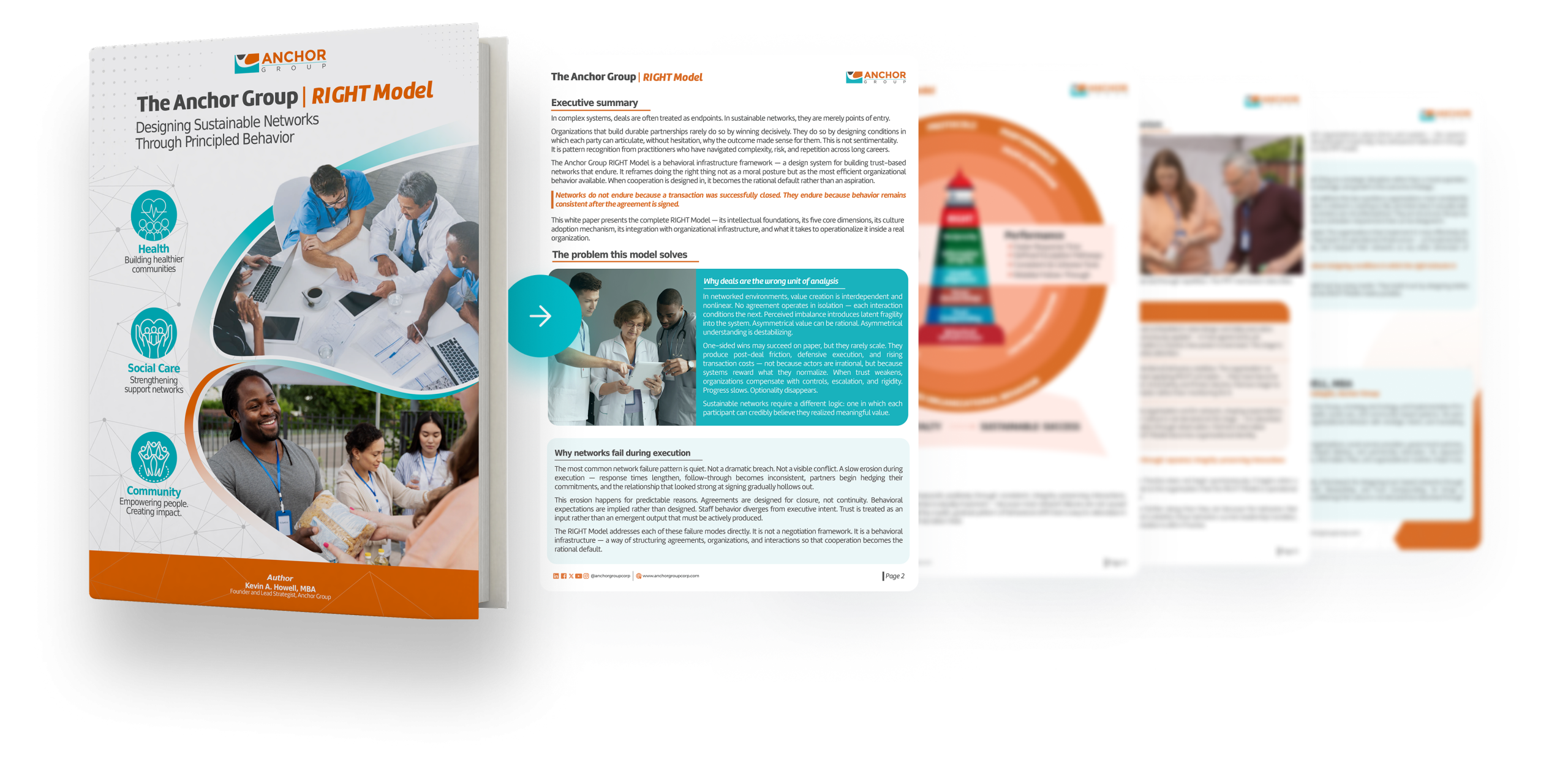
Designing sustainable networks through principled behavior.
The RIGHT Model is a design system for building trust-based networks that endure across health, social care, and community systems. It reframes doing the right thing not as a moral posture but as the most efficient organizational behavior available.
In sustainable networks, deals are points of entry not endpoints.
Most network failures are not dramatic breaches. They are slow erosions during execution. Response times lengthen, follow-through becomes inconsistent, partners begin hedging their commitments, and a relationship that looked strong at signing gradually hollows out.
Why deals are the wrong unit of analysis
In networked environments, value creation is interdependent and nonlinear. No agreement operates in isolation. Each interaction conditions the next. One-sided wins may succeed on paper, but they rarely scale. They produce post-deal friction, defensive execution, and rising transaction costs.
Why trust is an output, not an input
Agreements are designed for closure, not continuity. Behavioral expectations are implied rather than designed. Staff behavior diverges from executive intent. Trust is treated as an input rather than an emergent output that must be actively produced through repeated, integrity-preserving interactions.
Why systems reward what they normalize
When trust weakens, organizations compensate with controls, escalation, and rigidity. Progress slows. Optionality disappears. The RIGHT Model addresses each failure mode directly. Not as a negotiation framework, but as behavioral infrastructure.
Why cooperation must be designed in
When cooperation is designed in, it becomes the rational default rather than an aspiration. Sustainable networks require a different logic. One in which each participant can credibly believe they realized meaningful value, based on what they actually needed.
A self-reinforcing system in which the rational choice is also the trust-building choice.
From Network-Fragmented to Network-Generative.
Trust decay almost never announces itself. It follows a consistent four-stage pattern across organizational types and sectors. Organizations that detect decay early at Stage 1 or Stage 2 recover fully. Organizations that allow it to reach Stage 3 or 4 rarely restore the original relationship.
Micro-Inconsistencies
Small, accumulated moments where behavior does not match stated commitment. Neither party names them. Both notice them.
Defensive Posturing
Partners begin structuring interactions to protect against exposure. Communication becomes more formal. Openness declines.
Structural Compensation
Partners build workarounds. Audit requirements increase. Oversight replaces trust. The relationship becomes expensive to maintain.
Quiet Exit
The partner stops investing, stops referring, stops advocating. The relationship technically continues but functionally ends.
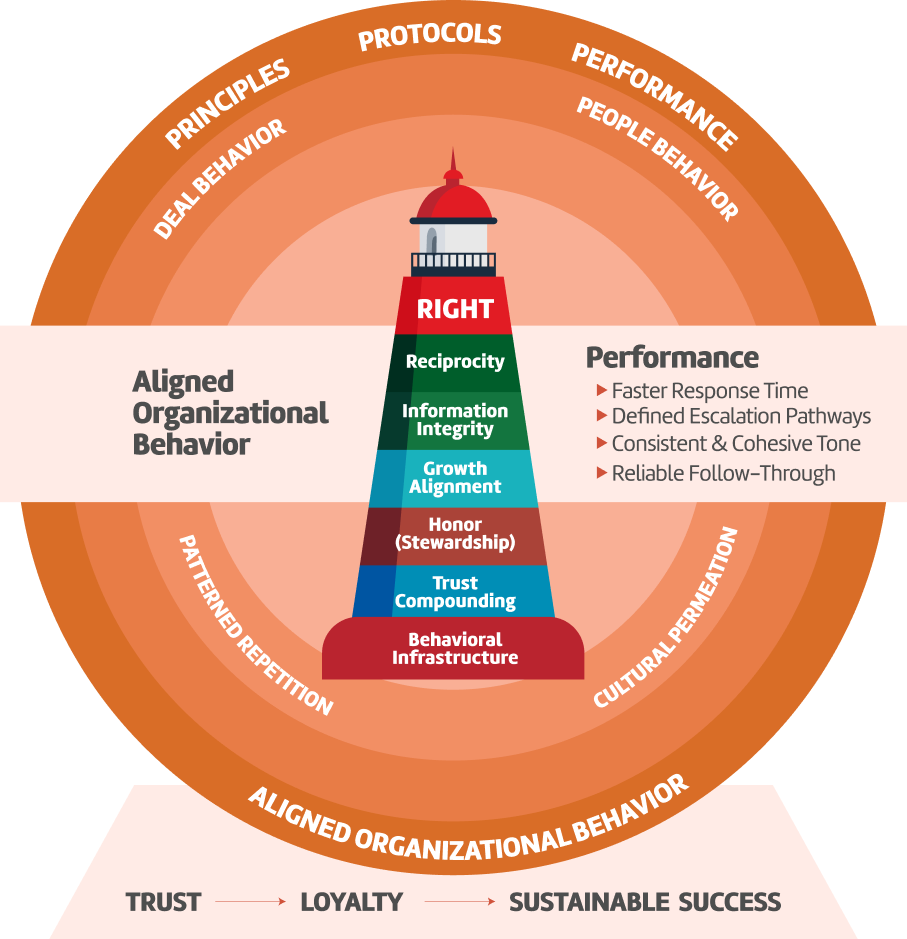
The PPP mechanism: how intentional behaviors become cultural defaults.
The RIGHT Model is not adopted through instruction. It is learned through repetition. Practice, Pattern, Permeation. The three stages by which behavior becomes infrastructure, and infrastructure becomes identity.
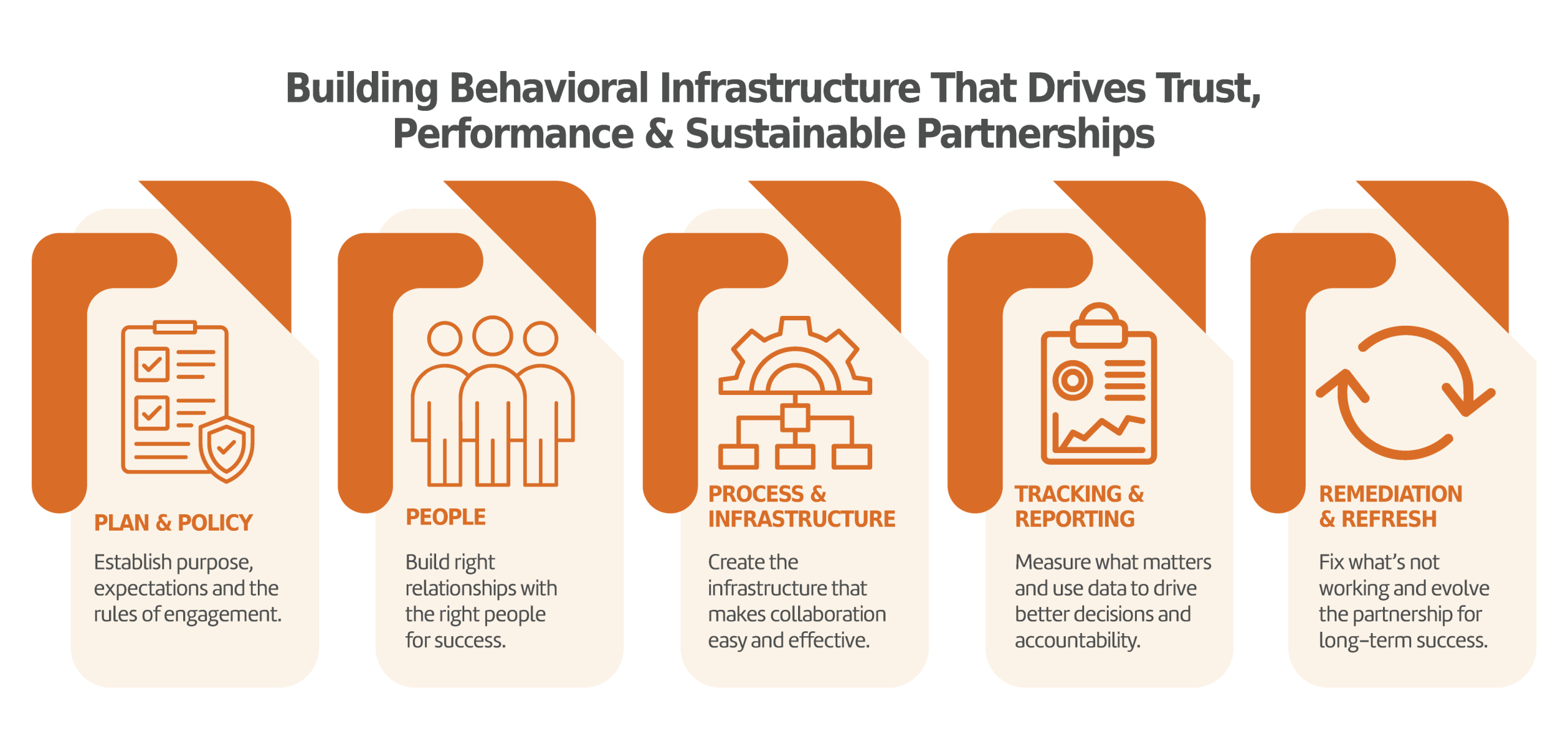
Intentional behaviors are embedded in deal design and daily execution. RIGHT principles are consciously applied in how agreements are structured, how information is shared, how power is exercised. This stage is effortful. It requires active attention.
Through repetition, intentional behaviors stabilize. The organization no longer has to think about applying RIGHT principles. They have become the expected standard. Uncertainty and friction decline. Partners rely on consistent behavior rather than monitoring for it.
Patterns permeate the organization and its network, shaping expectations without enforcement. Culture is not declared at this stage, it is absorbed. New staff adopt behaviors through observation. The RIGHT Model becomes organizational identity.
Culture, in this context, is not declared. It is absorbed through repeated, integrity-preserving interactions until cooperation becomes instinct.
Five bands describing how a network performs under pressure.
The RIGHT Model Diagnostic measures organizational network infrastructure readiness and places organizations into one of five bands. Each describes a distinct profile of network performance, relationship risk, and development priority.
Network-Generative
Infrastructure generates compounding network returns. The organization functions as a trusted node within a broader ecosystem.
Network-Ready
Strong infrastructure with specific documented gaps. Trust is actively reducing friction and enabling scale.
Network-Capable
Functional but inconsistent across dimensions. Real foundations built informally that will fracture under scale.
Network-Constrained
Meaningful gaps limiting network performance. Outcomes depend on individuals rather than systems.
Network-Fragmented
Immediate structured investment required. Partnerships are transactional and erode under any stress.
Start where it makes sense. Move when you are ready.
Download the white paper, take the free diagnostic, or move directly into structured implementation. No credit card required for the white paper or the free assessment tier.
No credit card required for whitepaper download or free assessment tier.
anchorgroupcorp.com · AssessNow™ Platform

Can every partner in your network articulate, without hesitation, why this relationship makes sense for them?
If the answer is yes across the network, consistently, not just with your strongest partners, the framework is working. If the answer is uncertain, partial, or unknown, the gap between intent and operational reality is the work to do.