

Designing Sustainable Networks Through Principled Behavior
In complex systems, deals are often treated as endpoints.
In sustainable networks, they are merely points of entry.
In conversations with experienced operators across sectors—including clinicians who have built and stewarded significant business assets—a consistent observation emerges: durable deals are rarely those where one party “wins” decisively. Instead, they are the agreements in which each side can articulate, without hesitation, why the outcome made sense for them. This is not sentimentality. It is pattern recognition from people who have navigated complexity, risk, and repetition over long careers.
Networks—whether ecosystems, platforms, or long-term partnerships—do not endure because a transaction was successfully closed. They endure because behavior remains consistent after the agreement is signed. Transactions optimize for closure; networks optimize for continuity. When this distinction is ignored, partnerships rarely fail loudly. They erode quietly—during execution.
The Anchor Group RIGHT Model is a design framework for building durable, trust-based networks. It reframes “doing the right thing” not as an ethical posture, but as behavioral infrastructure: a way of structuring agreements, organizations, and interactions so that cooperation becomes the rational default.
Why Deals Are the Wrong Unit of Analysis
In networked environments, value creation is interdependent and nonlinear. No agreement operates in isolation; each interaction conditions the next. As a result, perceived imbalance introduces latent fragility into the system. While asymmetrical value can be rational, asymmetrical understanding is destabilizing.
One-sided wins may succeed on paper, but they rarely scale. They produce post-deal friction, defensive execution, and rising transaction costs—not because actors are irrational, but because systems reward what they normalize. When trust weakens, organizations compensate with controls, escalation, and rigidity. Progress slows. Optionality disappears.
Sustainable networks require a different logic: one in which each participant can credibly believe they realized meaningful value.
The Anchor Group RIGHT Model
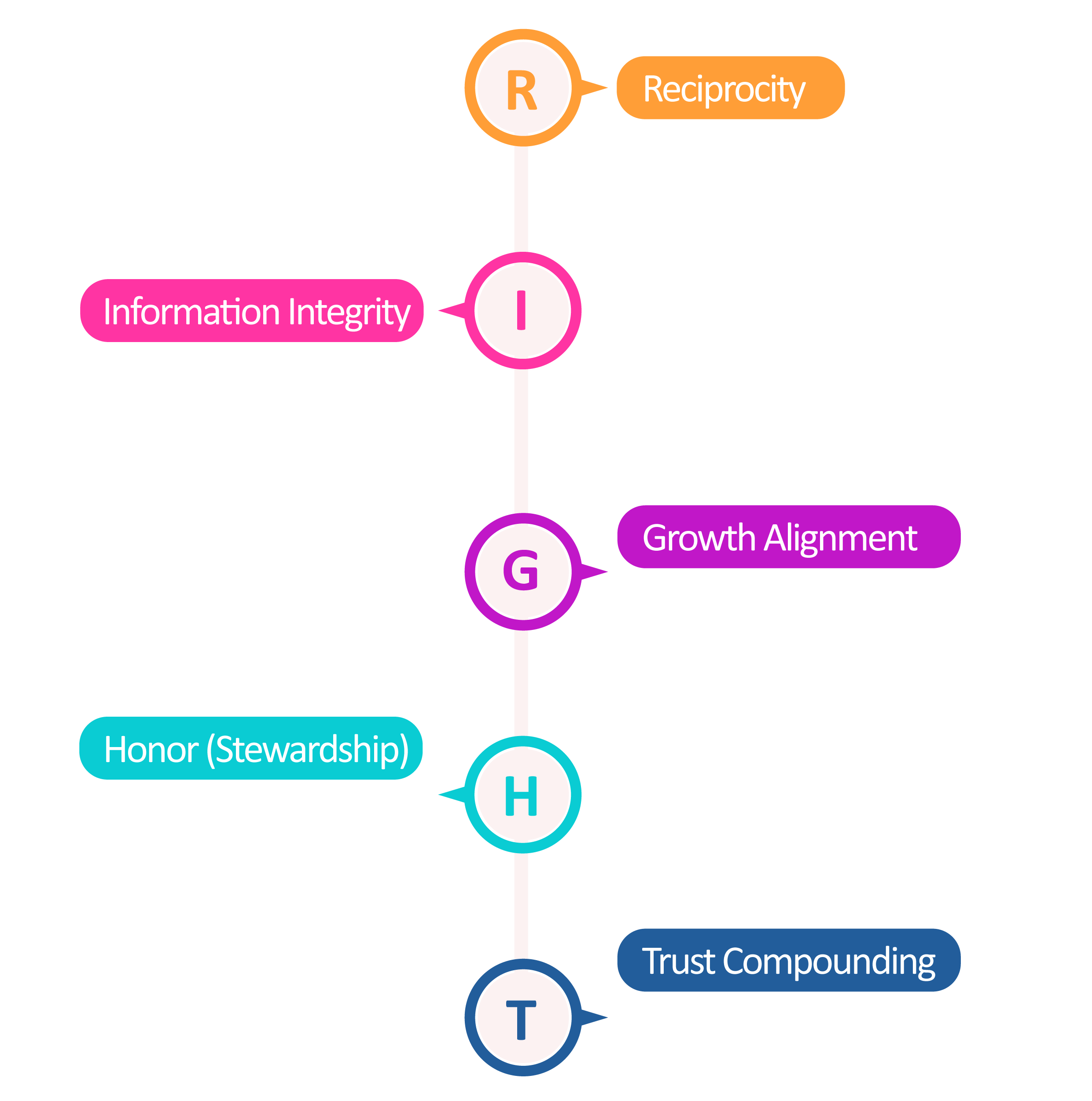
The Anchor Group RIGHT Model is designed to meet this requirement directly. It is not a theory of negotiation. It is a framework for structuring behavior in multi-party systems, where trust, alignment, and credibility must compound over time.
RIGHT is not about being agreeable. It is about designing conditions in which the “right” behavior is also the most efficient behavior.
The RIGHT Framework
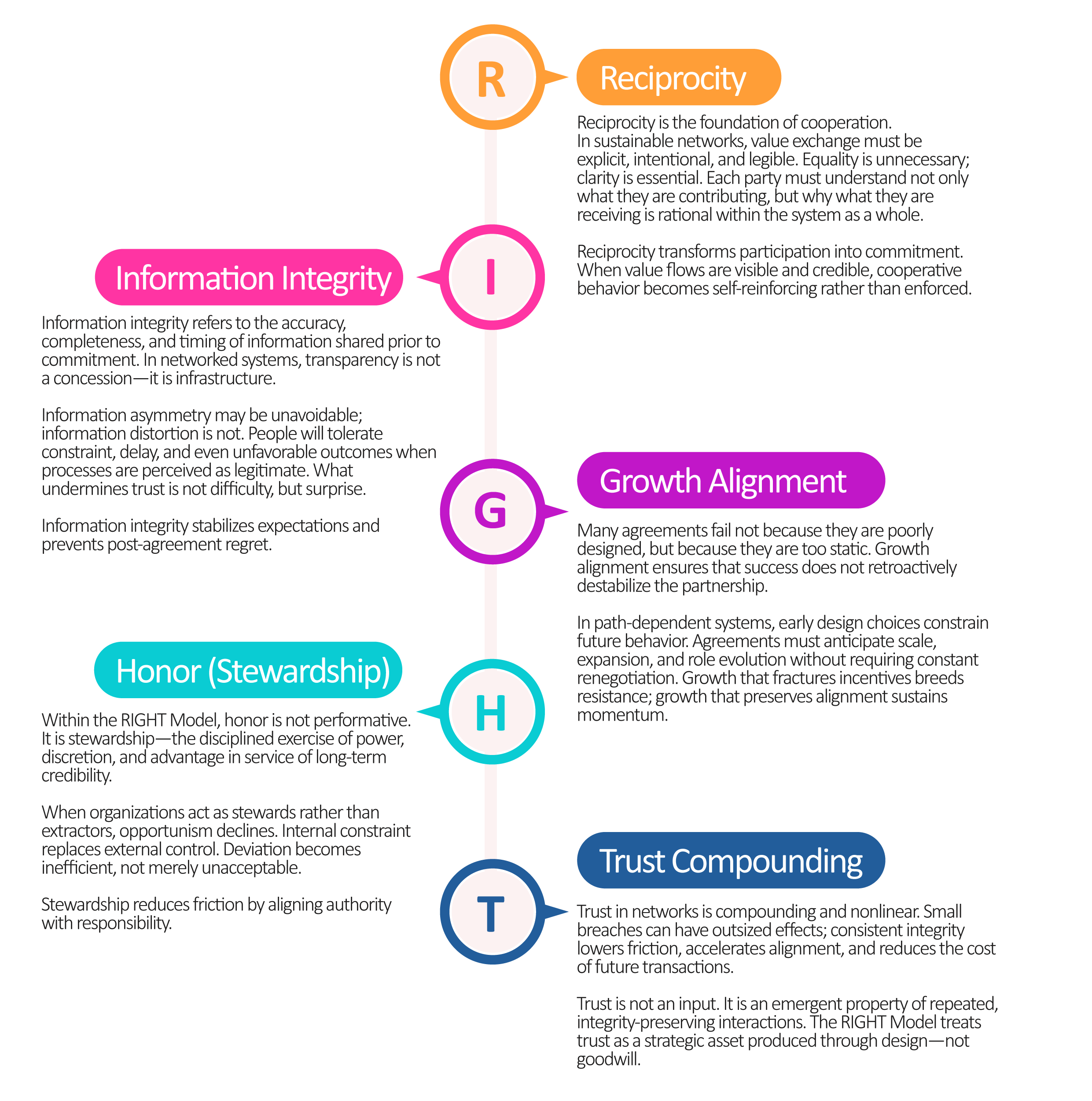
R — Reciprocity
Reciprocity is the foundation of cooperation. In sustainable networks, value exchange must be explicit, intentional, and legible. Equality is unnecessary; clarity is essential. Each party must understand not only what they are contributing, but why what they are receiving is rational within the system as a whole.
Reciprocity transforms participation into commitment. When value flows are visible and credible, cooperative behavior becomes self-reinforcing rather than enforced.
I — Information Integrity
Information integrity refers to the accuracy, completeness, and timing of information shared prior to commitment. In networked systems, transparency is not a concession—it is infrastructure.
Information asymmetry may be unavoidable; information distortion is not. People will tolerate constraint, delay, and even unfavorable outcomes when processes are perceived as legitimate. What undermines trust is not difficulty, but surprise.
Information integrity stabilizes expectations and prevents post-agreement regret.
G — Growth Alignment
Many agreements fail not because they are poorly designed, but because they are too static. Growth alignment ensures that success does not retroactively destabilize the partnership.
In path-dependent systems, early design choices constrain future behavior. Agreements must anticipate scale, expansion, and role evolution without requiring constant renegotiation. Growth that fractures incentives breeds resistance; growth that preserves alignment sustains momentum.
H — Honor (Stewardship)
Within the RIGHT Model, honor is not performative. It is stewardship—the disciplined exercise of power, discretion, and advantage in service of long-term credibility.
When organizations act as stewards rather than extractors, opportunism declines. Internal constraint replaces external control. Deviation becomes inefficient, not merely unacceptable.
Stewardship reduces friction by aligning authority with responsibility.
T — Trust Compounding
Trust in networks is compounding and nonlinear. Small breaches can have outsized effects; consistent integrity lowers friction, accelerates alignment, and reduces the cost of future transactions.
Trust is not an input. It is an emergent property of repeated, integrity-preserving interactions. The RIGHT Model treats trust as a strategic asset produced through design—not goodwill.
Why the Best Network Deals Feel Like a “Steal”
In well-designed networks, it is both possible and desirable for each party to believe they secured a favorable outcome. This perception is not accidental. It results from intentional alignment around what each participant values most—speed, certainty, control, learning, access, or long-term upside.
The best network agreements feel unfair in opposite directions, for different reasons. That tension is not a flaw. It is evidence of differentiated value realization.
From RIGHT to Culture: Practice, Pattern, Permeation (PPP)
The Anchor Group RIGHT Model is not adopted through instruction. It is learned through repetition.
RIGHT begins as practice—intentional behaviors embedded in deal design and daily execution. Through repetition, these behaviors stabilize into patterns, reducing uncertainty and friction. Over time, these patterns permeate the organization and its network, shaping expectations without enforcement.
Culture, in this context, is not declared. It is absorbed.
Alignment Between Deal Behavior and People Infrastructure
Sustainable relationships cannot be maintained when external deal behavior and internal people behavior diverge. A partnership may be negotiated at the executive level, but it is lived daily through staff actions—response times, escalation pathways, tone, and follow-through.
When organizational behavior contradicts contractual intent, mistrust develops in execution. When people infrastructure reflects the same principles embedded in agreements, execution reinforces trust rather than eroding it.
Consistency is the silent determinant of partnership durability.
Clients Return as Evidence, Not Strategy
Clients do not return because a single engagement was successful. They return because they trust how an organization behaves under pressure, ambiguity, and constraint.
Treating clients “right” is not a service philosophy. It is the byproduct of internal coherence—where deal behavior, people behavior, and execution behavior align. Loyalty, in this context, is evidence that the system is functioning as designed.
Conclusion: RIGHT as Strategic Infrastructure
The Anchor Group RIGHT Model reframes “doing the right thing” as a strategic discipline rather than a moral aspiration. In sustainable networks, trust is infrastructure, integrity is leverage, and growth is the outcome of design.
RIGHT is designed to be practiced, patterned, and absorbed.
When it is, cooperation becomes instinct.
That is how durable networks are built.
Research Foundations Informing the Anchor Group RIGHT Model
Reciprocity & Social Exchange
- Gouldner, A. W. (1960). The norm of reciprocity.
- Blau, P. M. (1964). Exchange and Power in Social Life.
Information Integrity, Fair Process & Trust
- Akerlof, G. A. (1970). The market for “lemons.”
- Thibaut, J. & Walker, L. (1975). Procedural Justice.
- Mayer, R. C., Davis, J. H., & Schoorman, F. D. (1995). Organizational trust.
Growth Alignment & Path Dependence
- Arthur, W. B. (1989). Increasing returns and lock-in.
- March, J. G. (1991). Exploration and exploitation.
Stewardship, Power & Long-Term Orientation
- Davis, J. H., Schoorman, F. D., & Donaldson, L. (1997). Stewardship theory.
- Ostrom, E. (1990). Governing the Commons.
Trust Compounding & Repeated Interaction
- Axelrod, R. (1984). The Evolution of Cooperation.
- Williamson, O. E. (1985). The Economic Institutions of Capitalism.
Culture Formation & Behavioral Normalization (Practice → Pattern → Permeation)
- Schein, E. H. (2010). Organizational Culture and Leadership.
- Lally, P. et al. (2010). Habit formation.
Author Biography
Kevin Howell is the Founder and Lead Strategist of Anchor Group, a strategy, technology, and implementation firm focused on designing sustainable networks across health, social care, and community-based systems. His work centers on building durable partnerships, aligning organizational behavior with strategic intent, and translating complex systems into practical operating models.
Over the past decade, Kevin has advised healthcare organizations, social service providers, government partners, and platform operators on network design, value-based delivery, and partnership execution. His approach emphasizes behavioral architecture—how incentives, information flow, and organizational routines shape trust, performance, and long-term collaboration.
Kevin is the creator of the Anchor Group RIGHT Model, a framework for designing trust-based networks through Reciprocity, Information Integrity, Growth Alignment, Stewardship, and Trust Compounding. He brings a systems-oriented perspective grounded in execution, believing that culture is not declared but absorbed through repeated behavior.